
Interesting correlation

I've been puzzling for some time over why gold took off when it did. Looking at this chart:
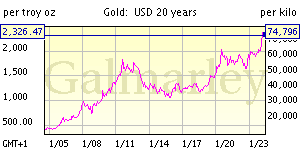
historic gold price chart

... you can see that gold "turned a corner" in the second half of 2005. This is a well-defined corner, the kind of corner that you see in the charts of the Great Depression or other significant economic events. Yet the global economy did not begin melting down until the last half of 2008, nearly three years down the road from that 2005 corner.

So, I asked myself, what was happening in mid-2005? Were there any significant events that year? It turns out that there was a significant event... the 7/7 London train bombing.

If you accept the hypothesis that the gold market is heavily manipulated and if you accept the hypothesis that 9/11 and 7/7 were likely false-flag events, then it's not a big leap to suggest a correlation between 7/7 and the gold price turning a corner in 2005 at almost exactly the same time.

Just a thought.

Comments

Popular posts from this blog

The Constitution has gone to the dogs

Actually, it should have gone to the dogs, but didn't. I'm talking about  Leona Helmsley's estate , of course. The contract clause of the Constitution says, "No State shall ... pass any ... Law impairing the Obligation of Contracts..." This means that private contracts cannot be changed by legislative edict. This clause is incredibly important because the willingness of private individuals to engage in profitable enterprise - which is the foundation of social welfare - crucially depends on their belief that they can realize a profit. In turn, their belief that they can realize a profit depends on their belief that they can hold parties to a contract liable to the terms in the contract. For example, lenders must have confidence that they can repossess the collateral for a loan if the loan is defaulted on. Otherwise, they will not take the risk of giving the loan in the first place. When lenders are too scared to lend, everyone is worse off. In the case of Leona Hel...
So, I spent all weekend watching JFK assassination videos and doing armchair JFK assassination research. Here are my notes: 1) Most of the debate seems to rage around trying to get evidence or proof that JFK's assassination was a conspiracy. This is silly because it grants - from the outset - the bizarre assumption made by the official theories that political figures are as likely to die at the hands of "mad attention-seekers" as they are to be assassinated by their enemies who actually stand to benefit. How many people are insane enough to think that the electric chair is a fair trade for "being remembered" by history, even if in infamy? And of those people how many are resourceful enough to pierce the security perimeter of the President of the United States? Kennedy was threatened by Richard Pavlick in 1960 after Nixon lost the election and, by all accounts, Pavlick was a lone nut. But all we know of his "assassination attempts" are his own tall tale...

What Law Is

Law What is law? Frederic Bastiat, in his treatise The Law, defines law as the collective use of force. As much as I love Bastiat’s treatise, I think his definition is not sufficiently analytical. It is certainly the case that the law plays a role in the collective use of force but the law is something more basic than this. We can begin by looking at law as it is today. The website for the Oregon courts has an excellent summary [1] of modern law and courts. I will quote it at length: Throughout history, people have had disputes and have needed some means to settle their disputes. As civil societies develop, they need an orderly system of conflict resolution. One system that developed in "western" cultures is the "law court" or court of law. In England, those early law courts developed a "body of law" called the common law, which defined both the rights of the people and the government and the duties people owe each other and their government. T...